Easily recognised from the other genera in the subfamily by the densely and finely hairy body. The abdomen is conical, markedly tapering to the tip and is often only bordered on the front segments. The tarsi are slender and long; hind tarsi as long as or longer than the hind tibia. Legs completely yellow; antennae yellow at least towards the base. The species are found under mouldy bark and in wood, amongst decaying leaves and flood debris. C. testaceum has often been found in underground nests.
While preparing the genitalia the inner sac of the aedeagus sometimes partly protrudes. If this happens what you see will be very different from the diagrams presented here.
#1
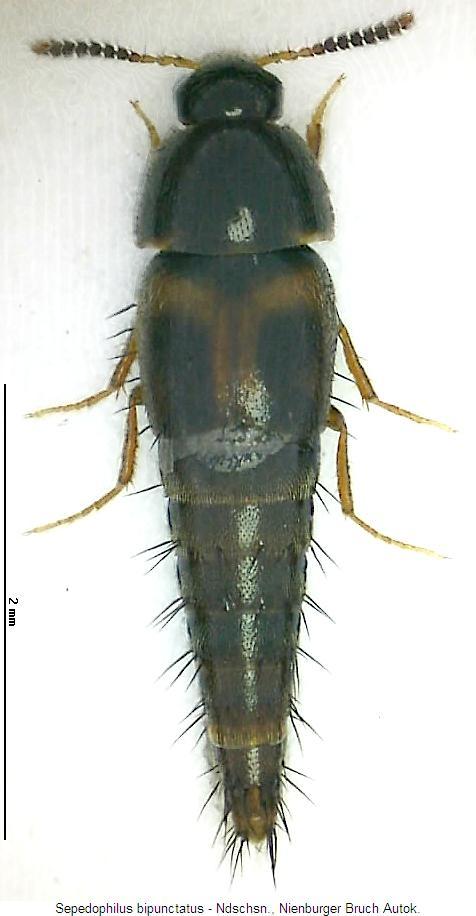
bipunctatus (Gravenhorst 1802)🗺Elytra and the exposed segments of the abdomen with long black bristles towards the sides. Black species with distinct golden yellow hair on the upper surface. Each elytron with a transverse yellowish red patch towards the base which usually broadly join across the suture [Abb. 1]. Length 2.0-2.5 mm. B: Associated with rotting hardwood. D: Widely distributed, but usually rare.
Abb. 1
→ 2-Elytra at most with only short, inconspicuous hairs towards the sides.
→ 4Elytra (measured along the suture) scarcely longer than the pronotum [Abb. 2]. Exposed tergites 2-4 with long black bristles towards the sides and rear (take care as they easily break off). Black species; elytra with a transverse, rectangular yellowish-red marking which doesn't extend to the sides or to the suture.
Abb. 2
→ 5-Elytra significantly longer than the pronotum. Exposed tergites 2-4 without long bristles along the hind margin but with a few shorter ones along the sides.
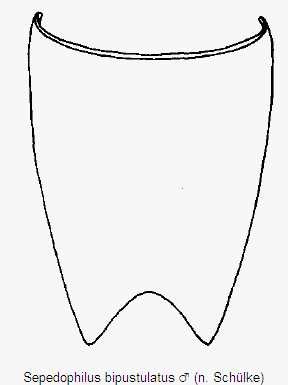
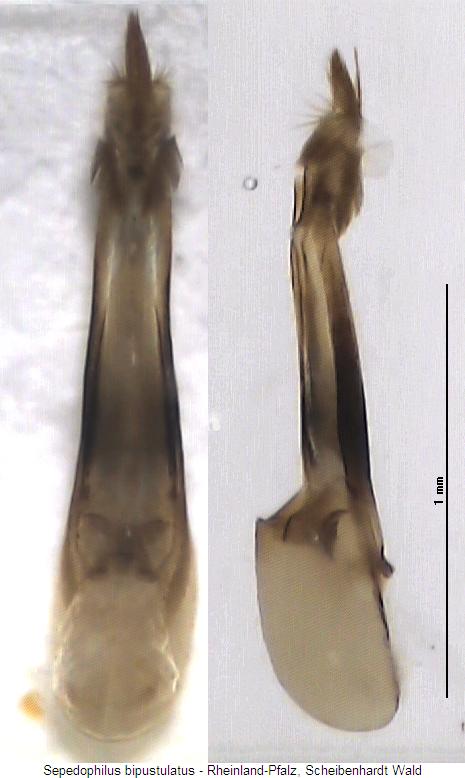
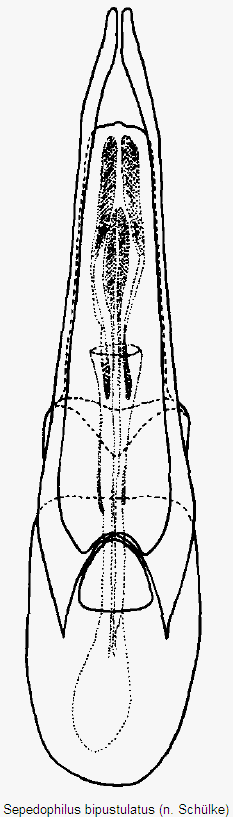
Rather larger species, 4.0-5.3 mm. Humeral marking on the elytra larger and more than a third the length of the suture. Punctures on the elytra more dense. ♂: Sixth visible sternite rather deeply notched on the hind margin [Abb. 3]; aedeagus about 1.35-1.45 mm long [Abb. 4]; parameres longer [Abb. 5]. D: South eastern species. In Central Europe particularly in the south east (Bavaria, Bohemia, Austria, Slovakia) in parkland on bracket fungi. Formerly the species has been taken in Denmark. Confirmed records from the west and north of Central Europe are only from the Rhineland-Pfalz region, as records for this species usually refer to the following one. ...bipustulatus (Gravenhorst, 1802)
Abb. 3Abb. 4Abb. 5
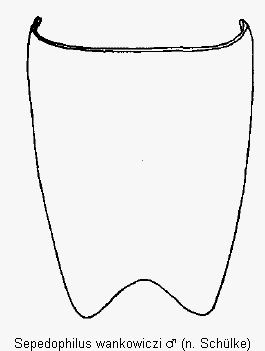
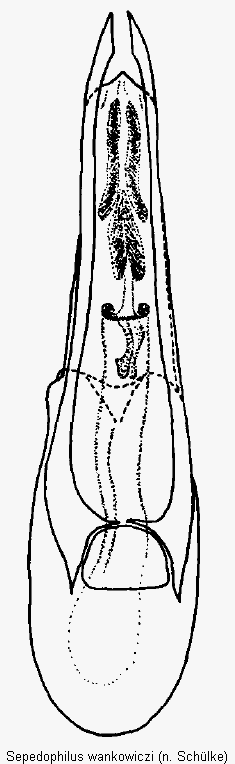
wankowiczi (Pandellé, 1869)🗺-Somewhat smaller species, 3.8-5.0 mm. Humeral marking on the elytra smaller, only about a third of the length of the elytra. Punctures on the elytra more dispersed. ♂: Sixth visible sternite less deeply notched at the tip [Abb. 6]; aedeagus smaller, 1.25-1.35 mm. long; parameres shorter [Abb. 7]. B: Ecology unknown but probably on bracket fungi like bipustulatus. D: Widespread Palaearctic species. Described from Lithuania but rarely collected there. Confirmed records are from around the Baltic, although its presence in north east Central Europe and Scandinavia cannot be ruled out.
binotatus (Gravenhorst, 1802)🗺Smaller species, 3.0-3.5 mm. The hind edge of the pronotum is evenly curved; the hind angles are blunt and scarcely extended backwards; pronotum more convex in section. Upper surface with brownish-yellow hairs. Antennae short with the second to last segment almost broader than long. Black with the hind margin and hind angles of the pronotum ± reddish; elytra with an indistinctly edged large red basal marking which extends to the sides and beyond half the length of the elytra. D: Scattered and rare in the middle and south of Central Europe (Baden-Württemberg (Karlsruhe)).
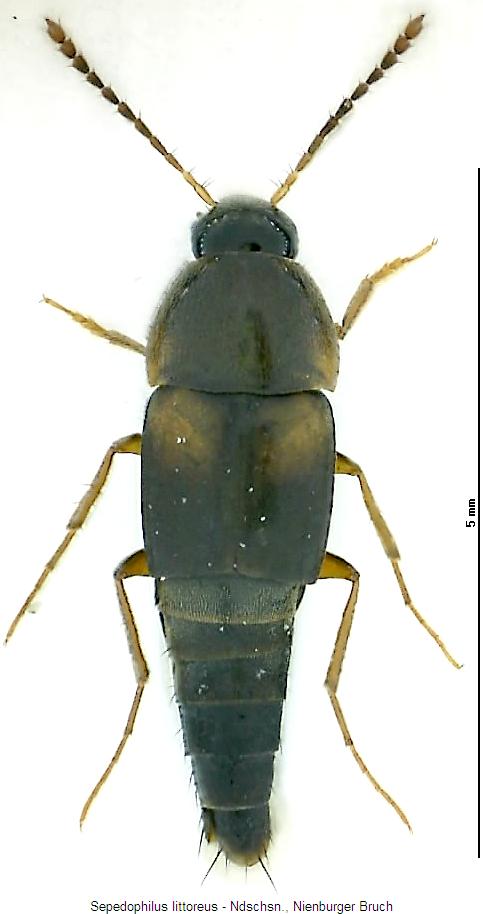
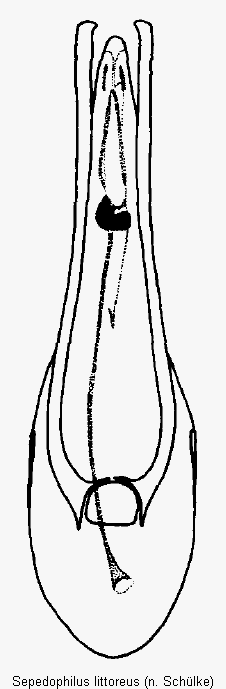
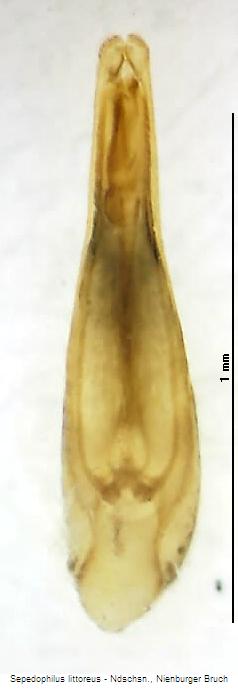
littoreus (L., 1758)🗺-Larger species, 4-5 mm [Abb. 8]. The hind margin of the pronotum has an even lobe in the middle in front of the scutellum and the hind angles project backwards; the pronotum is flatter in section. Upper surface densely grey-hairy. Antennae longer and more slender with the second to last segment not broader than long. Black species with the sides of the pronotum clearly yellowish particularly in the rear half. Elytra either with a reddish-yellow marking at the base which does not extend to the suture or the sides or half way back, or they are distinctly paler in colour than the rest of the upper surface. In the latter case the base of the elytra is pale right across and extends back to the rear of the suture forming a sharp angle. Transitional forms occur between these extremes but in all of them the area around the scutellum is usually dark. Aedeagus [Abb. 9][Abb. 10]. D: The commonest of the bicoloured species..
→ 12Pronotum with the microscopic sculpture very dispersed or absent. Antennae short with segments 8-10 clearly broader than long [Abb. 11]. Smaller species, 2.0-3.2 mm.
Abb. 11
→ 7-Pronotum with a close transverse microscopic sculpture. Segments 8-10 of the antennae at most only slightly broader than long. Length 2.5-5 mm.
→ 8Antennae less elongate with segment 7 not longer than its apical width; segments 8-10 clearly broader than long.
→ 9-Antennae more elongate with segment seven clearly longer than its apical breadth and segments 8-10 not broader than long. Upper surface uniformly yellowish-red to blackish-brown or blackish-brown with reddish elytra. Larger on average. ♂: front tarsi clearly dilated; aedeagus larger with various inner chitinous armature.
immaculatus (Stephens, 1832)🗺Smaller species, 2.5-3.5 mm. Abdomen with longer bristles at the sides. Middle part of the antennae brown. Elytra about as long as the pronotum. Pronotum and elytra very finely and quite densely punctured. Black with the hind margin of the pronotum, the elytra and the exposed tergites narrowly paler translucent. D: Not uncommon and widely distributed.
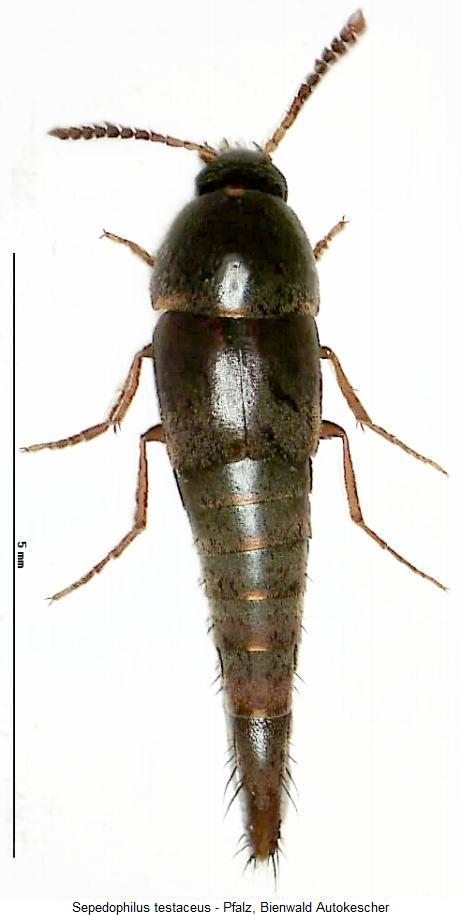
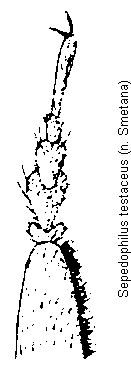
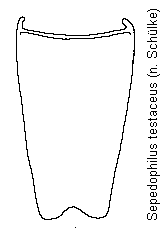
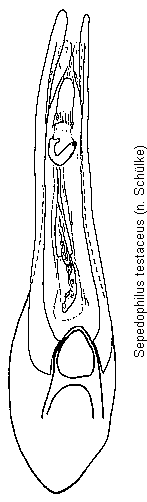
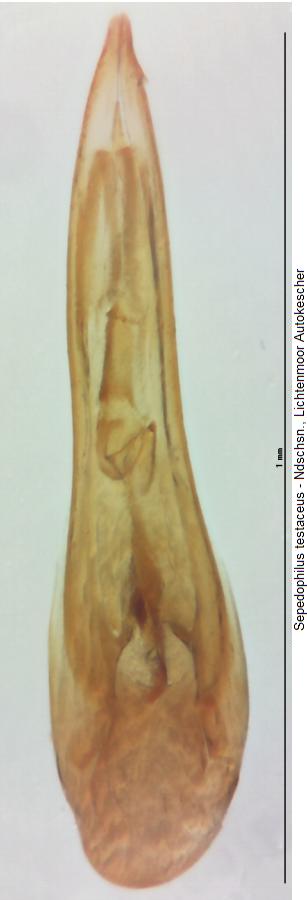
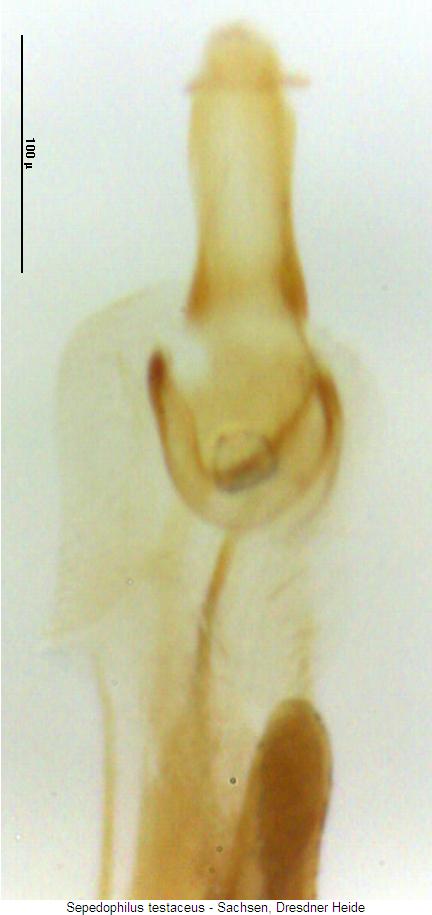
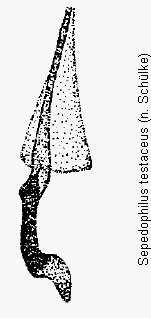
testaceus (F., 1792)🗺-Larger species, 3.5-4.5 mm. Upper surface uniformly brownish-black [Abb. 12]. Exposed segments of the abdomen finely bristled. ♂: Front tarsi slightly dilated [Abb. 13]; sternite 6 with a broad and even incision on the hind edge [Abb. 14]; aedeagus small [Abb. 15][Abb. 16] with relatively simply constructed ejaculatory duct [Abb. 17]; basal part of the inner sac [Abb. 18]. B: Often under bark or in rotting wood. D: Widely distributed and generally common.
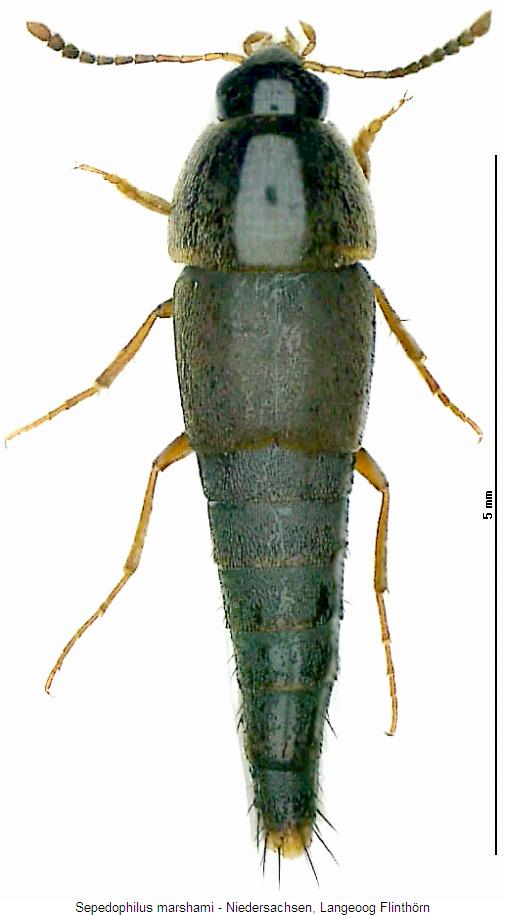
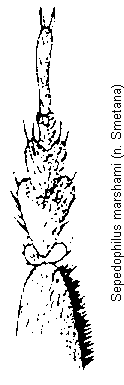
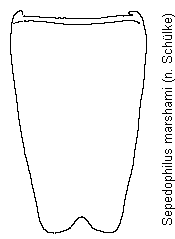
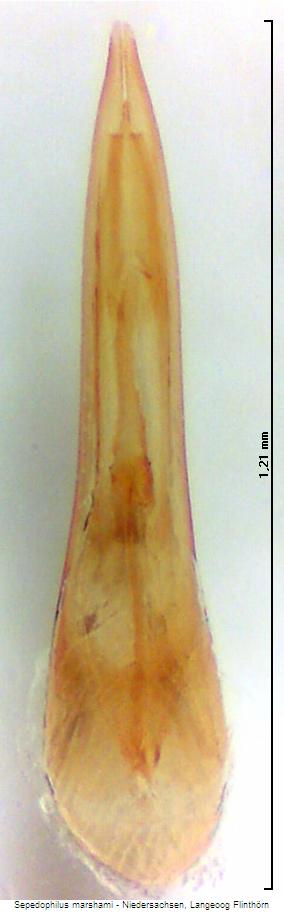
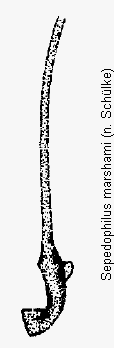
marshami (Stephens, 1832)🗺Body usually ± distinctly two-coloured with the head, pronotum and abdomen blackish-brown and the elytra dark reddish brown with the sutural angle and the sides darker. Some specimens are however more or less uniform [Abb. 19]. Exposed segments of the abdomen with long strong bristles at the sides. Length 3.8-4.8 mm. ♂: Front tarsi distinctly dilated [Abb. 20]; sternite six very elongate with a characteristic even and narrow incision on the hind margin [Abb. 21]; aedeagus large [Abb. 22][Abb. 23] with a simple ejaculatory duct; basal part of the inner sac [Abb. 24]. B: Differing from testaceus by being often found in leaf litter, but also found in dead wood. D: Widely distributed and generally common.
Abb. 19Abb. 20Abb. 21Abb. 22Abb. 23Abb. 24
-At least the head and pronotum are uniformly yellowish-red to blackish-brown. Elytra never significantly paler. ♂: Sternite six shorter with a broad incision on the hind margin. Aedeagus with the inner structure otherwise. ...10
#10
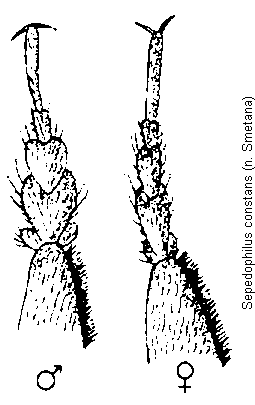
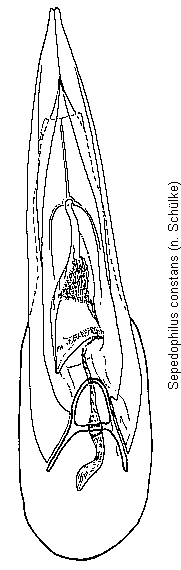
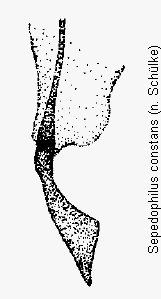
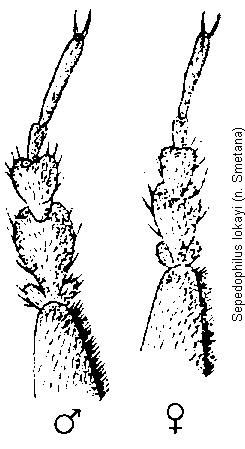
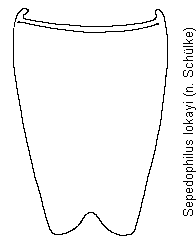
constans (Fowler, 1888)🗺Upper surface uniformly brown to black. Punctures of the pronotum dispersed. Abdomen with the lateral bristles very short. Female: front tarsi scarcely dilated. Length 3.9-4.9 mm. ♂: Front tarsi clearly dilated [Abb. 25]; sixth sternite short [Abb. 26], aedeagus large and robust [Abb. 27] with the tube dilated, trumpet-like with distinctly sclerotised hooked tips; parameres clearly exceeding the median lobe of the aedeagus; basal part of the inner sac [Abb. 28]. B: In flood debris and on ·Armillaria mellea·. D: Mainly montane in Central Europe, recorded from Bohemia, Slovakia, Germany (Thuringia, Lower Saxony and Bavaria), Austria (Tyrol, Styria) and Switzerland (Berne). (=strigosus J. Sahlb.) (=stoeckli Lokay)
Abb. 25Abb. 26Abb. 27Abb. 28
→ 11-Upper surface uniformly brown to black or red with the base of the abdomen darkened. Punctures on the pronotum denser. Lateral bristles on the abdomen short. ♂: Sixth sternite longer.
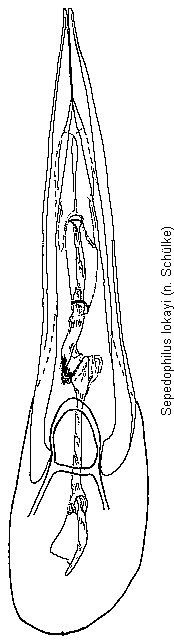
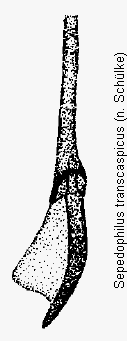
transcaspicus (Bernhauer, 1917)🗺Head and pronotum yellowish-red. Abdomen ± darkened towards the base. Female: front tarsi clearly dilated. Length 4.1-4.9 mm. ♂: front tarsi very strongly dilated [Abb. 29]; sixth sternite with a deep incision [Abb. 30], aedeagus very large [Abb. 31], with long ejaculatory duct with a distinctly sclerotised, rounded tip; parameres reaching considerably beyond the median lobe of the aedeagus; basal part of the inner sac [Abb. 32]. D: Isolated records from Bohemia, Moravia, Slovakia, Austria (Burgenland) and Germany (Saxony, Brandenburg, Mecklenburg-West Pomerania and North Rhine-Westphalia). (=lokayi (Smet., 1969))
Abb. 29Abb. 30Abb. 31Abb. 32
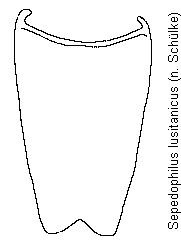
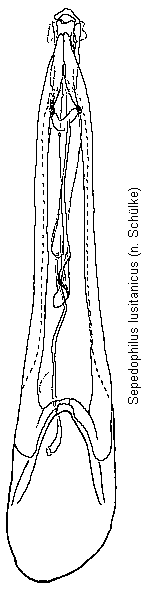
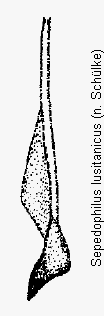
lusitanicus Hammond, 1973🗺-Upper surface uniformly brown to blackish-brown. Length 4.3-5.1 mm. ♀: Front tarsi not dilated. ♂: Front tarsi less strongly dilated; sixth sternite with a shallow incision [Abb. 33]; aedeagus smaller and narrower [Abb. 34] with a simple ejaculatory duct without a strongly sclerotised tip; parameres scarcely longer than the median lobe; basal part of the inner sac [Abb. 35]. B: In rotting wood and pine litter. D: Western European species, recorded from Belgium and Great Britain, possibly extending into the west of Central Europe.
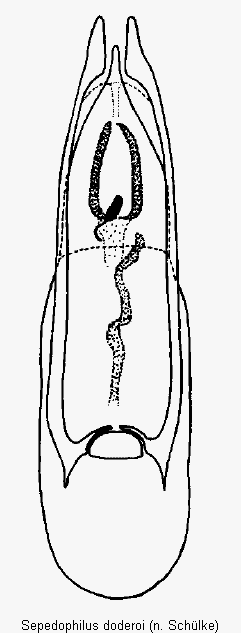
doderoi (Gridelli, 1931)🗺Reddish brown species with the head and abdomen darker brown, the tergites broadly bordered reddish brown. Pronotum with a dense transversely reticulate microscopic sculpture, scarcely visible between the fine punctures. Hind margin of the fifth complete visible tergite without a membranous border. ♂: Aedeagus [Abb. 37]. D: At higher altitudes in the western Alps (Simplon, Mount Rosa etc.); has also been recorded from the Ötztal Alps. (=monticola FHL. nec Woll.)
Abb. 37
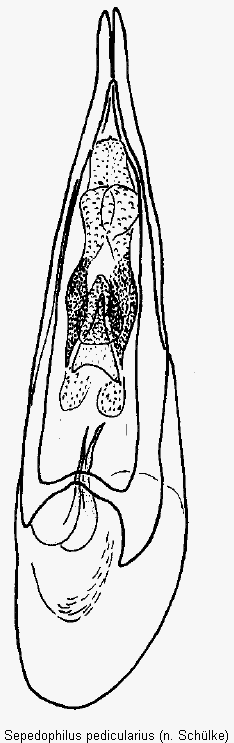
pedicularius (Gravenhorst, 1802)🗺-Uniformly pitch black species with the hind margins of the elytra and pronotum translucently paler. Elytra very short with their length measured along the suture significantly shorter than the pronotum measured along the mid line. Hind margin of the pronotum sinuate near the sides. Hind angles of the pronotum projecting backwards, rounded and weakly pointed. Hind margin of the fifth complete tergite with a membranous border. ♀: Tergite 8 with a broader median incision, rounded at its base. ♂: Aedeagus [Abb. 38]; sternite 8 with a weakly rounded incision at the base. D: Widely distributed and not uncommon.
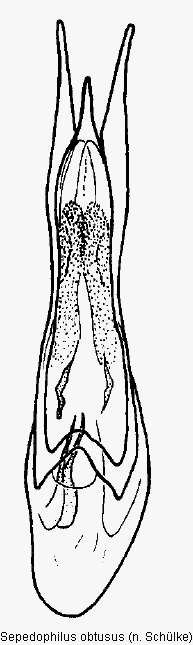
obtusus (Luze, 1902)🗺Uniformly pitch black species with the hind margins of the elytra and pronotum translucently paler. Pronotum without any trace of a leathery texture. Elytra relatively longer, the length along the suture about as long as the pronotum measured along the mid line. Hind margin of the pronotum not sinuous towards the sides. Hind angles of the pronotum not projecting backwards, weakly obtuse- to right-angled, broadly rounded. ♀: Tergite 8 with a narrower pointed incision. ♂: Aedeagus [Abb. 39]; sternite 8 with a pointed incision. D: Widely distributed and not uncommon in the south.
Abb. 39
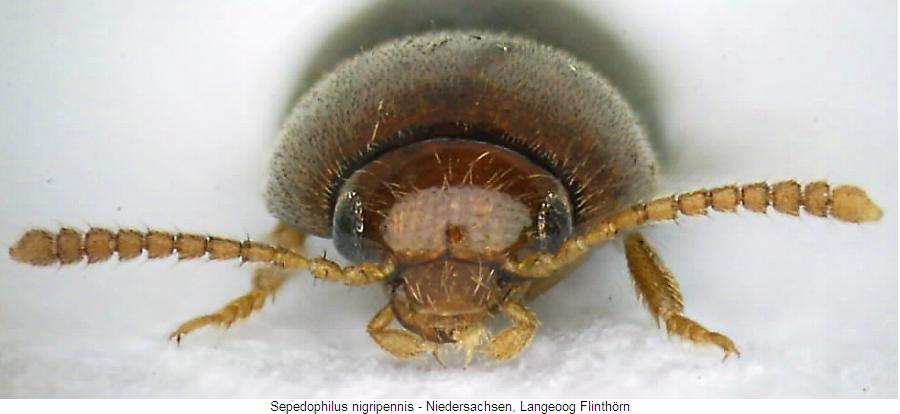
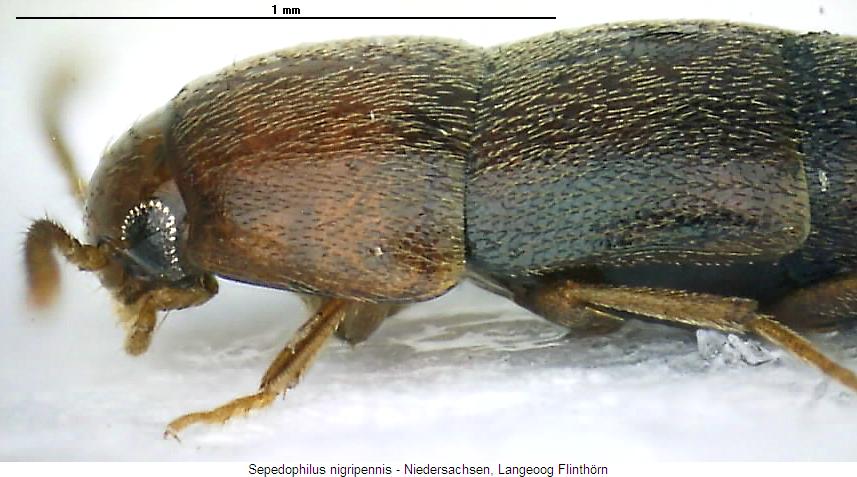
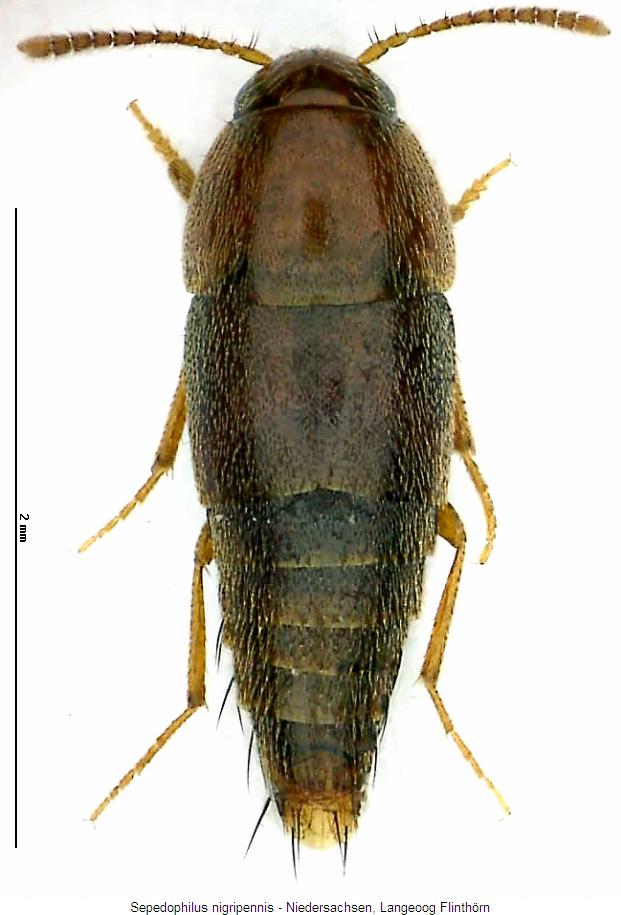
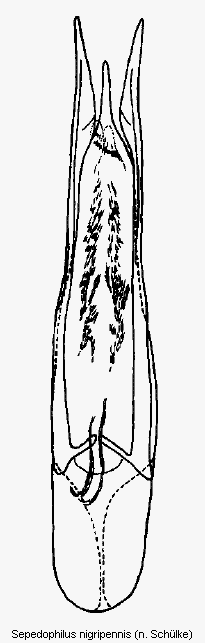
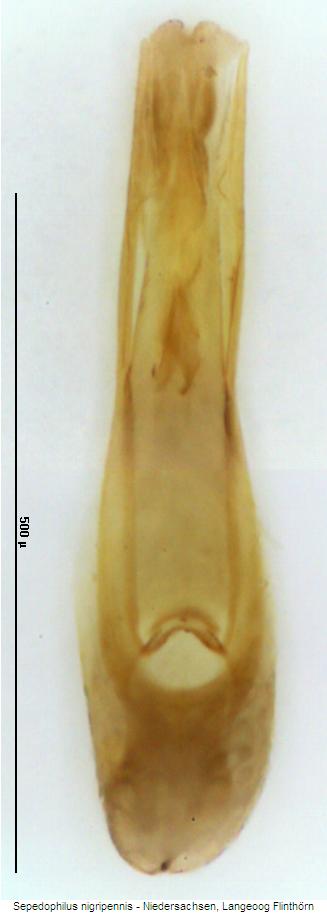
nigripennis (Stephens, 1832)🗺-Yellowish-red species [Abb. 40], sometimes with the elytra and the base of the abdomen darkened. Pronotum with a weaker microscopic sculpture, which is very weak in the front half, not forming a closed network. Elytra 1.2 times as long as the pronotum measured along the mid line. Punctures on the elytra denser than both the preceding species and more clearly transversely ridged than in obtusus. Aedeagus [Abb. 41][Abb. 42]. Length 2-3 mm. D: Atlantic-Mediterranean species. Distributed across the whole of Central Europe but rare, only commoner in the west and towards the coast.
 🗺
🗺 Elytra and the exposed segments of the abdomen with long black bristles towards the sides. Black species with distinct golden yellow hair on the upper surface. Each elytron with a transverse yellowish red patch towards the base which usually broadly join across the suture [Abb. 1]. Length 2.0-2.5 mm. B: Associated with rotting hardwood. D: Widely distributed, but usually rare.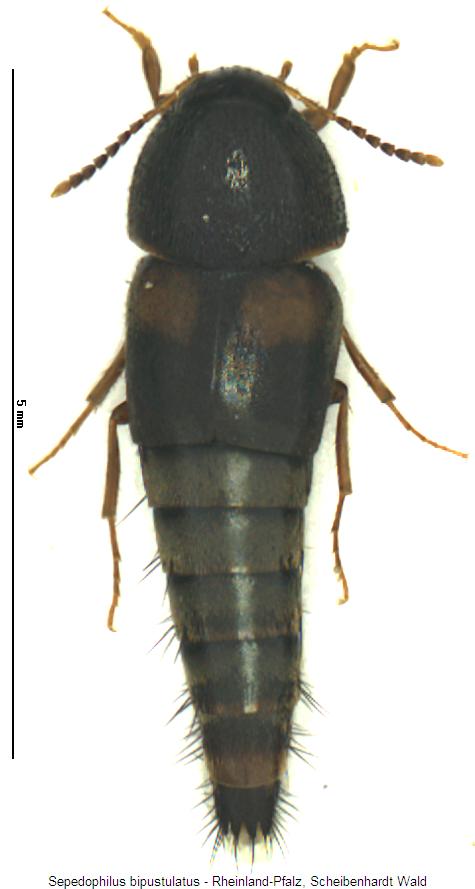








 Käfer Europas herausgegeben von Arved Lompe sind lizenziert unter den Bedingungen der Creative Commons International 4.0 Lizenz BY-SA (Namensnennung-Weitergabe unter gleichen Bedingungen)