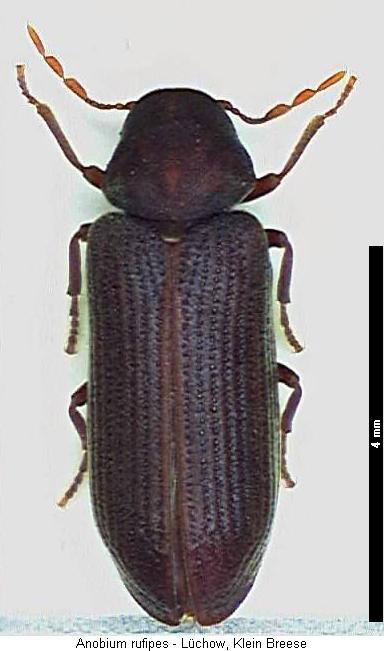
Antennae 11-segmented, filamentous with the last three segments significantly elongated. Pronotum with a tubercle and a complete border (rarely interrupted in the middle). Elytra densely and shortly covered with prostrate hairs and with distinct rows of punctures. Front coxae divided at the base. Length 2.5-7.5 mm. Includes the species formerly classified in genus Anobium which have now been separated into several genera.
#1
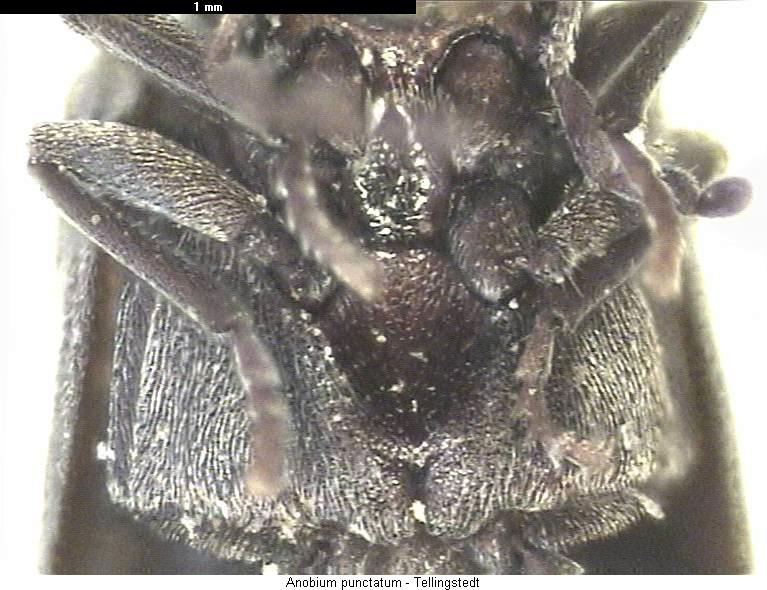
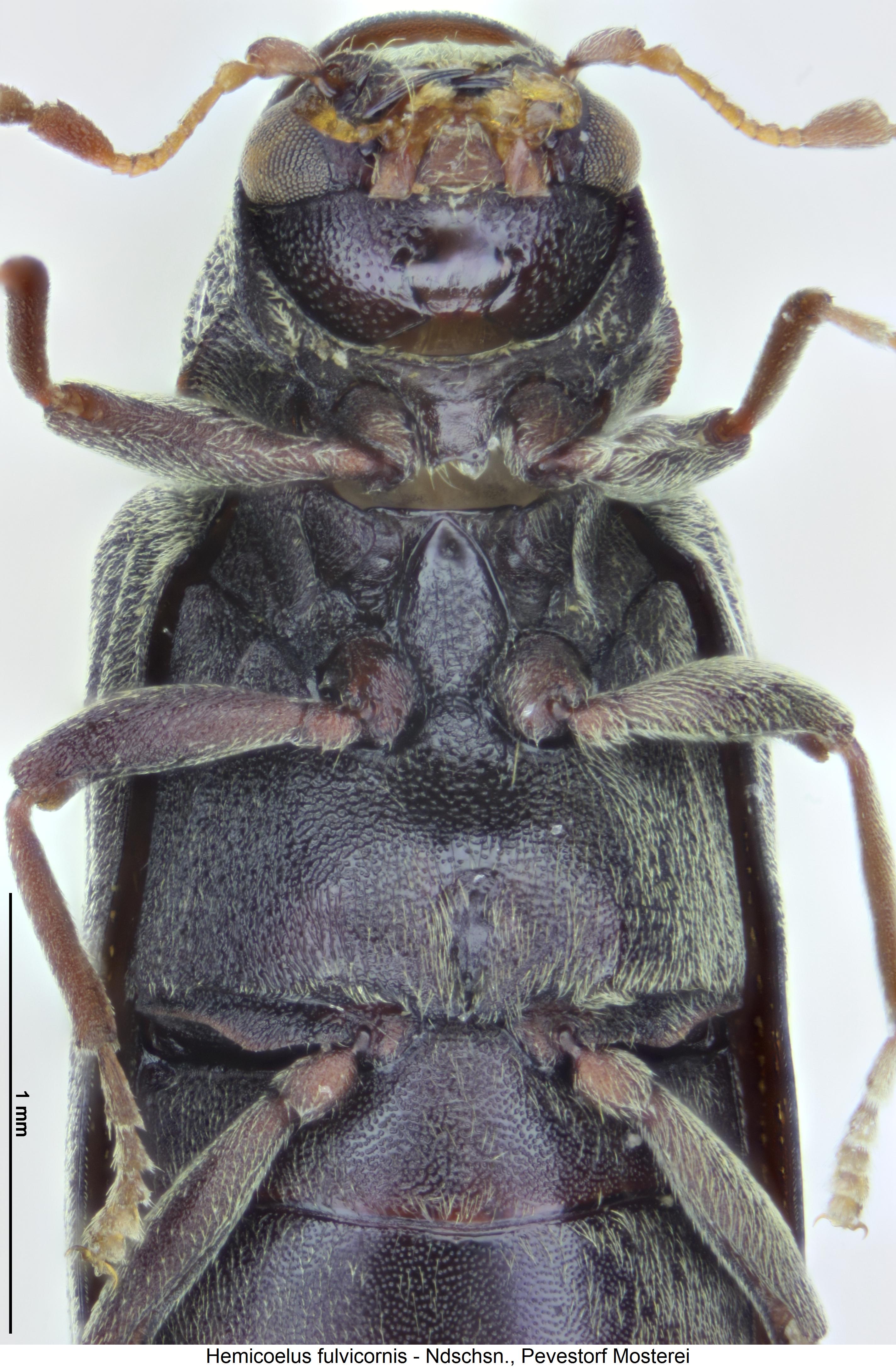
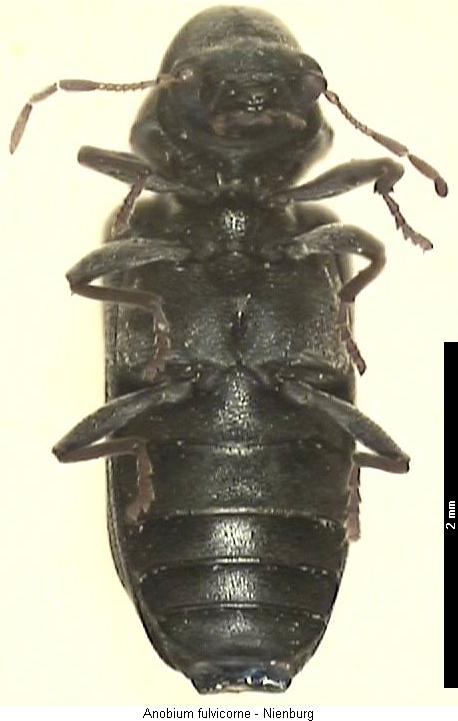
→ 2Underside with a deep depression between the middle coxae which extends across the whole of the mesosternum and often almost the whole of the metasternum. The edge of the depression is steep-sided [Abb. 1].
Abb. 1
-The depression between the middle coxae is less extensive and extends onto at most the front part of the metasternum. If in doubt the sides of the depression are gentle [Abb. 2]. ...3
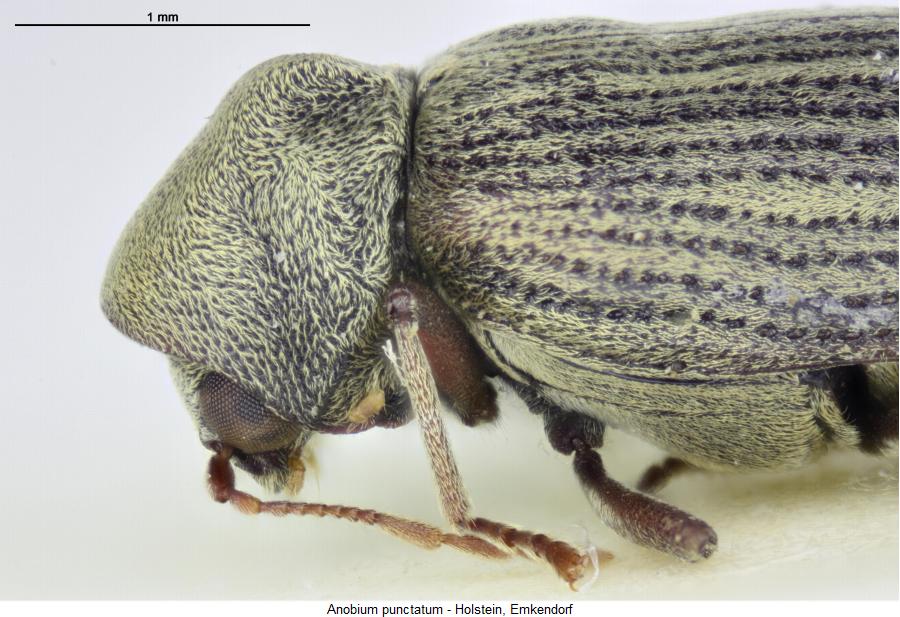
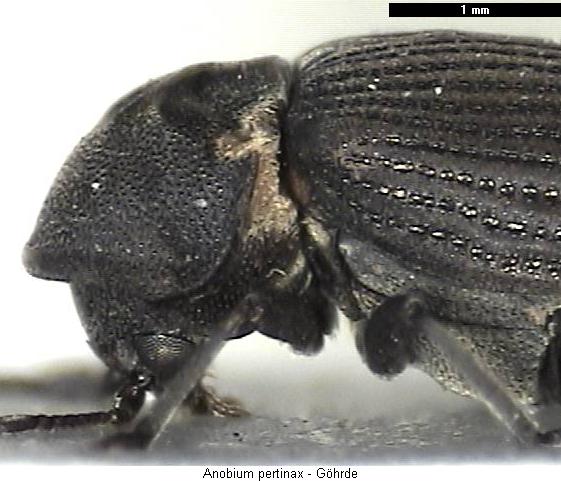
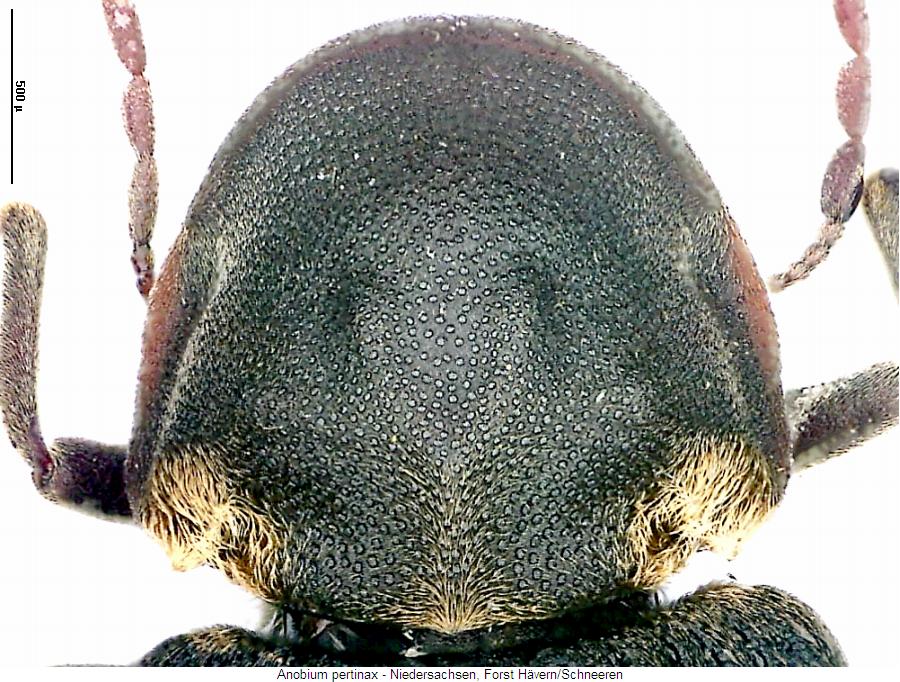
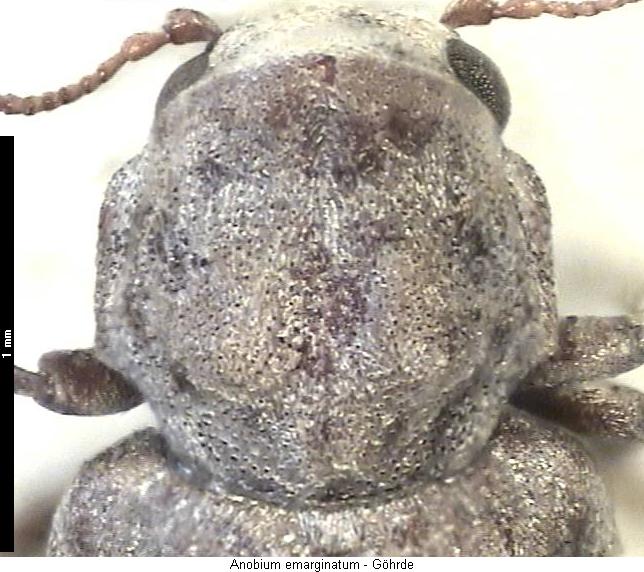
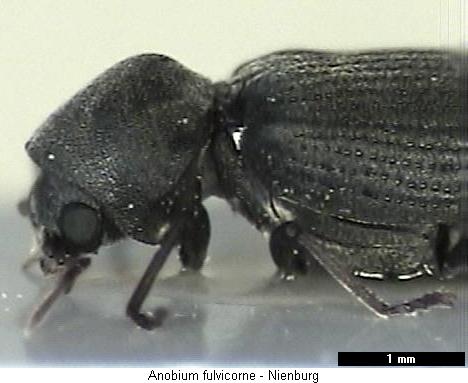
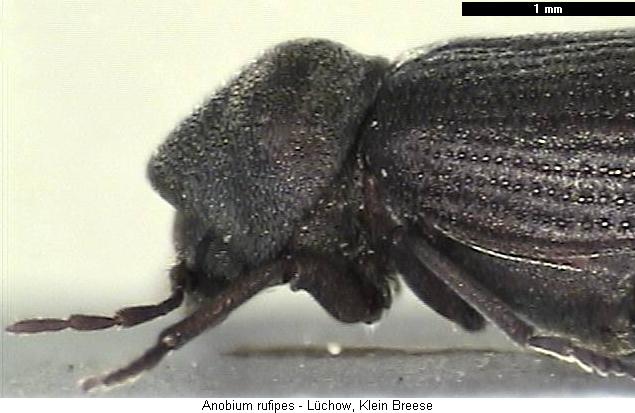
Hadrobregmus Thomson, 1859The first abdominal sternite is longer than the third. Pronotum with a tubercle whose sides converge towards the rear and with a fine median line which fades towards the front. Viewed from the side the rear third of the pronotum slopes steeply towards the elytra [Abb. 3]. ...Anobium Fabr. The first abdominal sternite is shorter than the third and the tubercle on the pronotum is bordered towards the front, i.e. marked by an impression or furrow and sloping gently towards the rear [Abb. 4]. Abdominal sternites united towards the middle with the suture interrupted. Front angle of the pronotum obtuse; hind angles not shifted far towards the front [Abb. 5]. (Coelostethus Lec., Dendrobium Muls.Rey). Closely related to Priobium and placed together with this genus in tribe Hadrobregmini.
Abb. 3Abb. 4Abb. 5
#3
First abdominal sternite as long as or longer than the third [Abb. 6]. Pronotum as in Anobium s.str with rounded sides and distinctly narrowed towards the front; the tubercles, in side view, are usually as shown [Abb. 7], rarely not as clearly domed and less steeply sloping towards the rear. Metasternum with a weak impression. ...4 First abdominal sternite shorter than the third, the sternites with the sutures between them complete. Mesosternum with a weak impression; metasternum not impressed. Pronotum parallel-sided in the middle or slightly narrowing towards the rear [Abb. 8] with the front angles right-angled. Hind angles sharply rectangular, shifted a long way forward. ...Microbregma Seidlitz, 1889
Abb. 6Abb. 7Abb. 8
#4
Tubercle on the pronotum distinctly raised (as in punctatum), viewed from the side steeply sloping towards the base (Fig 7). Elytra not starting to slope until within the rear third with each elytron bluntly truncate at the tip. Very similar to Anobium punctatum when viewed from above. ...Hemicoelus LeConte, 1861 Tubercle on the pronotum less clearly expressed not laterally compressed and only gently sloping towards the rear [Abb. 9]. Each elytron rounded to a point at the tip [Abb. 10]. Elytra (when viewed from the side) beginning to gently slope from just beyond the middle. ...Cacotemnus LeConte, 1861
 Käfer Europas herausgegeben von Arved Lompe sind lizenziert unter den Bedingungen der Creative Commons International 4.0 Lizenz BY-SA (Namensnennung-Weitergabe unter gleichen Bedingungen)